Make complex security and governance requirements operational.
Oculus helps regulated and high-consequence organizations — healthcare, financial services, insurance, government, and critical infrastructure — turn fragmented security and AI oversight obligations into a working, repeatable practice.
Who we work with
Two practices for operational security and governance
Choose the practice that matches your operating problem — or start with the assessment that reveals where to begin.
Continuous Security
Bring findings, risk decisions, remediation, and evidence into one operating workflow.
Explore Continuous SecurityAI Governance
Discover how AI is used, tier the risk, and establish practical governance paths.
Explore AI GovernanceSecurity and governance requirements outgrow ad hoc effort
Findings pile up across scanners, audits, and vendor reviews. Risk decisions live in someone’s head instead of a record. Remediation stalls without an owner. Evidence gets rebuilt from scratch for every audit or review. This is true whether the pressure comes from a compliance framework, a regulator, a customer security questionnaire, or your own board — the operating problem is the same.
Continuous Security
A working system for identifying, evaluating, responding to, and reporting on security findings — across your cloud, your tools, and your compliance obligations, including FedRAMP, DoD Cloud, and IC authorizations where that applies to you.
FedRAMP
Including FedRAMP, DoD Cloud, and IC authorizations where that applies to your organization.
AI Governance
You cannot govern AI you cannot see. An assessment-driven starting point for understanding where AI is used in your organization and building the oversight to match.
Explore AI GovernanceFrom assessment to operational practice
A repeatable approach for building security and governance workflows that hold up under real use.
Discover current state
Inventory what exists today — systems, controls, findings, tools, and who owns what.
Identify operating gaps
Find where findings, decisions, remediation, or evidence are falling through the cracks.
Design the workflow
Build the process, roles, and reporting that fit your organization and your requirements.
Implement and validate
Put the workflow into practice and confirm it holds up under real use.
Improve and automate
Reduce manual effort over time as the workflow matures.
Practical expertise, not box-checking
Operational judgment, technical depth, and governance workflows designed to leave teams more capable.
Operational, Not Performative
We focus on workflows teams can run, not policies and documents that sit unused.
Security and Governance Together
We understand both the technical source systems and the evidence leadership needs.
Built for Complex Environments
Our approach comes from federal, cloud, defense, and regulated operating contexts.
Useful Before Expansive
We begin with a bounded problem and prove the workflow before recommending a larger program.
Automation with Judgment
We automate repeatable work while preserving human accountability for consequential decisions.
Capability That Compounds
Each engagement is designed to leave the client with a stronger internal capability, not permanent dependence on Oculus.
Built by someone who's been in the room
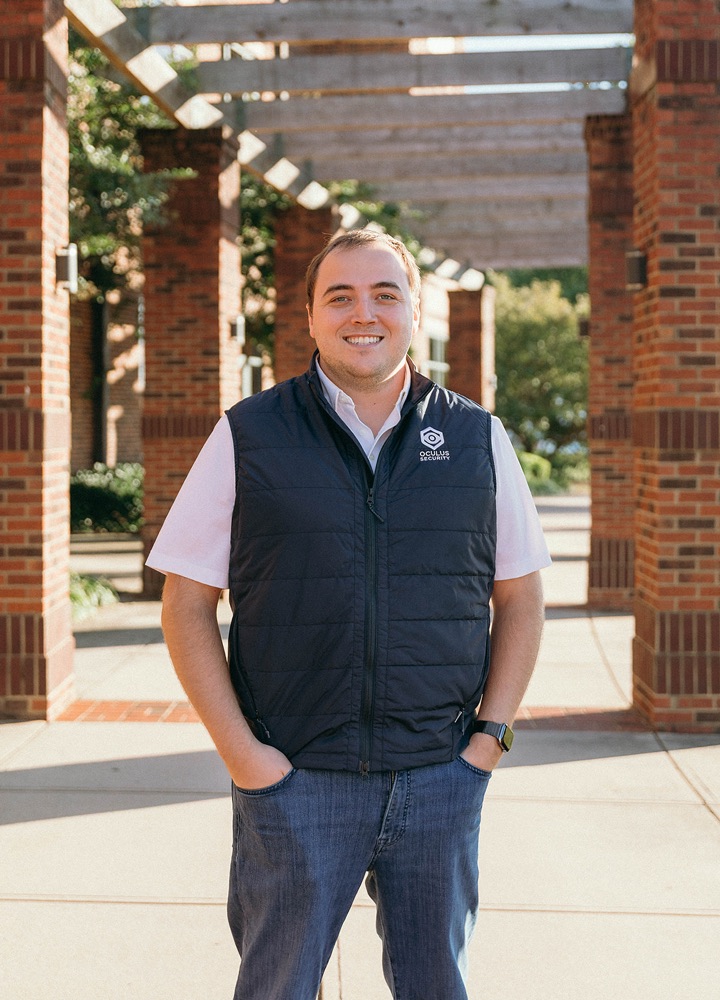
Patrick Clark
Founder & Principal
A South Carolina native, I earned my BS in Computer Science from Clemson University. Today I work with teams embedded, remote, or hybrid, wherever the mission calls for it.
Across government, cloud, and defense technology, Patrick repeatedly saw the same failure: security requirements were documented separately from the systems and teams expected to operate them. Oculus Security was founded to close that gap — turning compliance and governance obligations into practical, evidence-producing workflows.
I've spent the last decade working at the most demanding intersection of technology, compliance, and decision-making: meeting federal security requirements at scale. Across the intelligence community, a global cloud provider, and a defense-focused platform, I've led the teams and the authorizations that turn compliance from a roadblock into a path to mission.
US Intelligence Community
~4.5 yearsGovernment staffer working ICD 503 and NIST SP 800-53 in classified environments, where I learned the real bottleneck isn't technical architecture, it's translation between engineers and decision-makers.
Amazon Web Services
~3 yearsHelped customers navigate FedRAMP journey. Saw firsthand what works and why most treat compliance as a binary gate rather than a solvable problem.
Leading Defense PaaS
~18 monthsLed the FedRAMP High authorization for a leading platform-as-a-service serving DoD mission workloads at Impact Levels IL4 and IL5. Hands-on ATO leadership cemented that authorization is achievable with the right people asking the right questions.
“All problems have solutions. We just need to work together to find the best one.”
Latest from the blog
Perspectives on security operations, federal authorization, and governance.
What requirement is your team struggling to operationalize?
Whether you are reconciling fragmented security findings, preparing for ongoing FedRAMP requirements, or trying to understand how AI is already being used across your organization, we can help define the problem and the next practical step.
contact@oculussec.com